
Foundation Inspection Los Angeles
Table of Contents
The Critical Role of Foundation Inspections in Los Angeles
Few things matter more for a Los Angeles building than the condition of its foundation. Given the area’s high seismic activity and variable soils–from expansive clays to sandy fill–a foundation inspection Los Angeles property owners trust must be a thorough structural evaluation. That’s why a structural engineer foundation inspection by our in-house team goes beyond surface checks: we examine stem-wall and slab cracks, signs of settlement or heaving, moisture intrusion, corroded rebar, and failed anchor bolts or connectors. These findings directly inform seismic retrofit planning, revealing when a soft story retrofit or non-ductile concrete building strengthening is needed to meet Los Angeles standards. Catching small issues early prevents costly escalation. Understanding the condition of your foundation is the essential first step before any retrofit or repair work begins.
Why Los Angeles Properties Require Regular Foundation Inspections
The high seismic activity in Southern California means that even minor foundation cracks can become major structural problems. A foundation inspection in Los Angeles is the first step toward identifying hidden vulnerabilities before they escalate. We understand how local conditions accelerate foundation wear, and we know that early detection through routine checks is critical for long-term safety.
The region’s expansive clay soils and hydro-collapsible earth shift with moisture changes, stressing concrete slabs and footings. Hillside erosion adds further risks to foundation integrity. That’s why a foundation inspection in Los Angeles is recommended as part of ongoing maintenance–routine evaluations can distinguish between harmless surface cracks and signs of active settlement that demand professional attention.
Los Angeles also contains a large stock of older buildings, many with soft-story configurations. These wood-frame structures with tuck-under parking are especially vulnerable during seismic events, and a soft story retrofit often becomes necessary after a foundation assessment reveals insufficient lateral support. Recognizing these risks early helps property owners plan upgrades proactively.
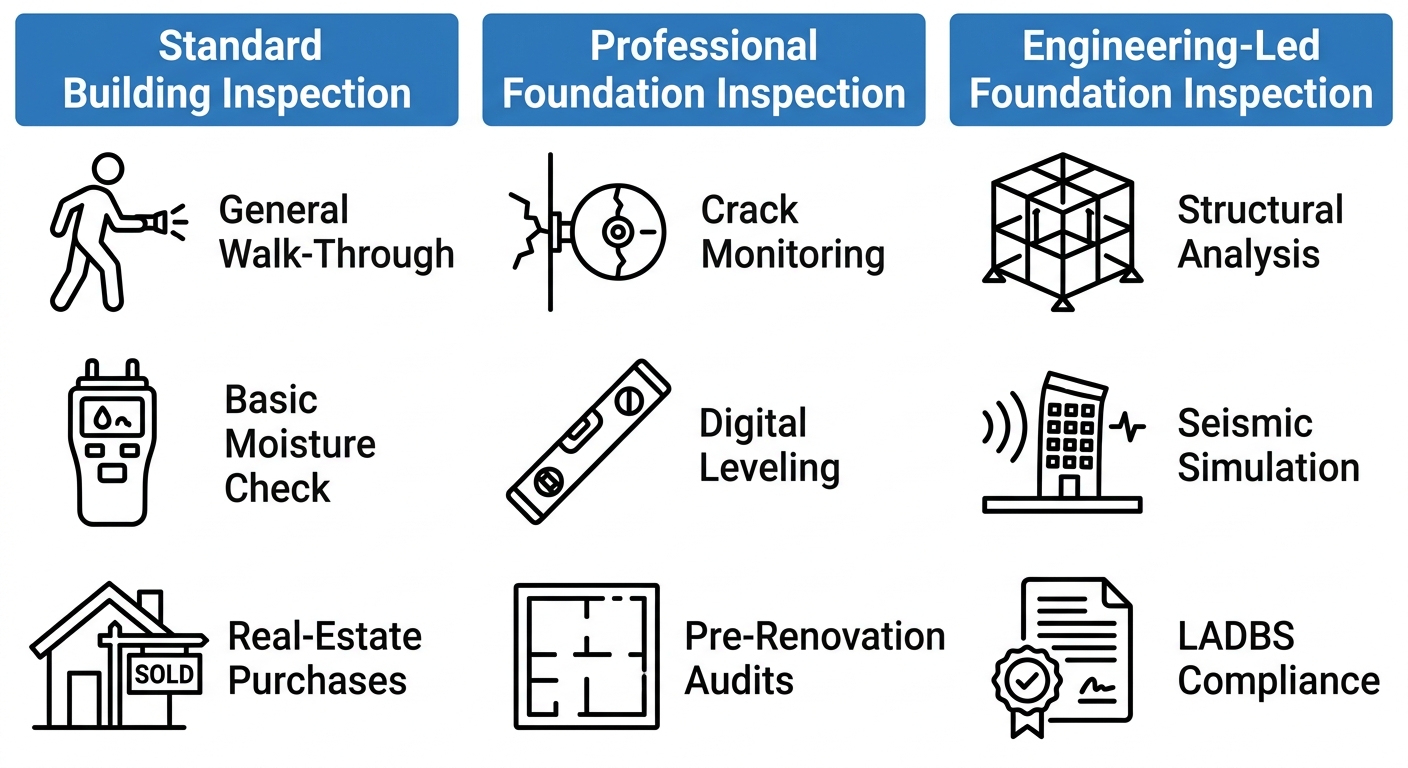
Because properties across Los Angeles face such varied risks, not all inspections are the same–the type needed depends on the structure, its age, and its condition. For suspected settlement or seismic planning, a structural engineer foundation inspection provides the most detailed analysis. The following table outlines three common inspection levels.
| Inspection Type | Scope & Focus | Who Conducts | Key Tools/Methods | When Required |
|---|---|---|---|---|
| Standard Building Inspection | General condition of structure; visual walk-through | Home inspector or general contractor | Flashlight, moisture meter, basic level; report notes visible defects | Real-estate transactions, routine maintenance |
| Professional Foundation Inspection | Detailed assessment of foundation elements, cracks, settlement, waterproofing | Specialized foundation contractor or certified inspector | Crack monitors, digital levels, soil probes; structural commentary included | After signs of distress, pre-renovation, periodic commercial audits |
| Engineering-Led Foundation Inspection | Comprehensive structural analysis, load-path evaluation, seismic assessment | Licensed structural engineer (PE/SE) | FEM modeling, concrete-scanning, deflection calculations, seismic simulation | Seismic retrofit design, crack-repair engineering, compliance with LADBS mandates |
After an inspection identifies foundation issues, we guide property owners on next steps. Standard inspections suit routine transactions, but cracking or seismic exposure demands a professional or engineering-led evaluation.
Our team at American Builders Inc. brings decades of hands-on Los Angeles foundation experience to every project, helping clients reinforce what matters.
Professional Foundation Inspection Services in Los Angeles
We prioritize a thorough foundation inspection in Los Angeles as the essential first step before any repair, construction, or seismic retrofit work. Our inspections begin with a focused visual and diagnostic assessment to identify signs of structural distress, establish the foundation type, and determine whether further engineering evaluation is required. We describe findings clearly so owners can make informed next-step decisions.
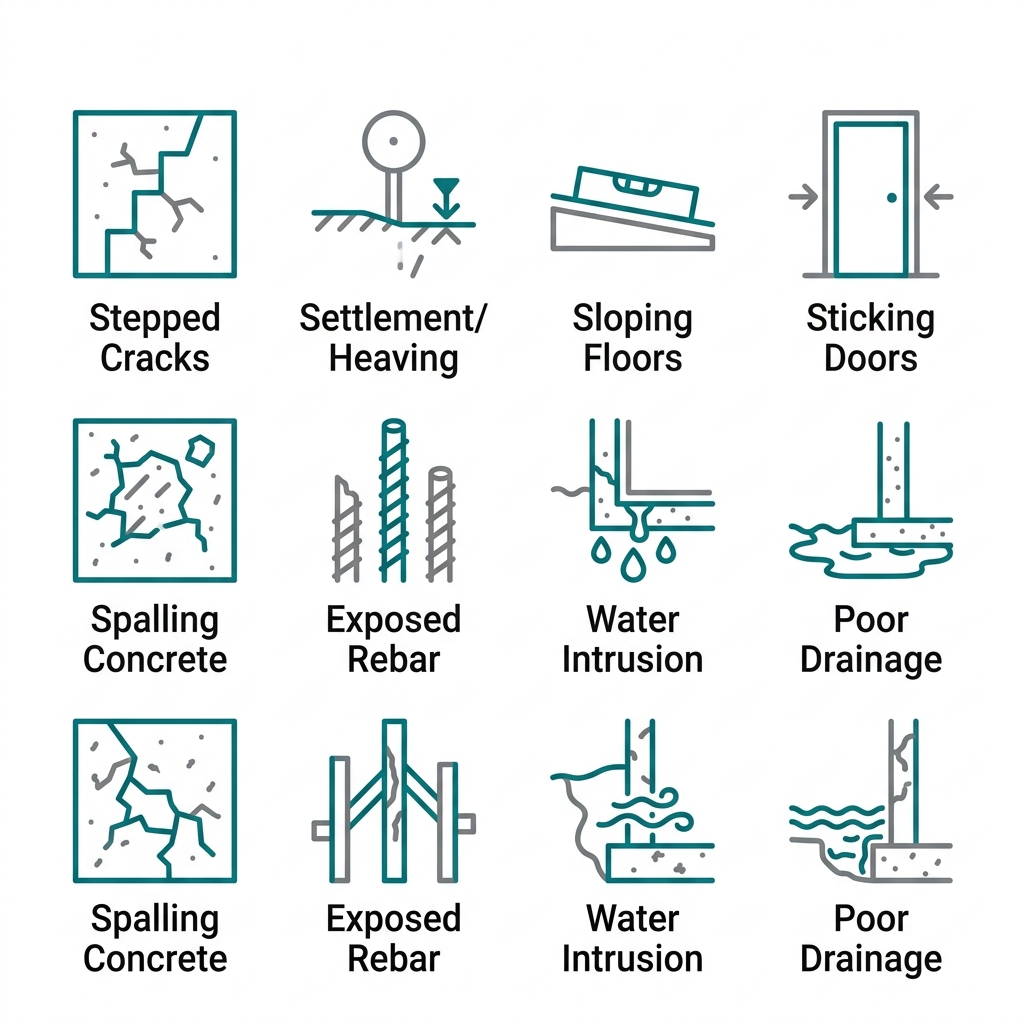
Our structural inspection process is a detailed interior and exterior walkthrough. We identify foundation types–raised wood-frame, slab-on-grade, post-tensioned slab, and perimeter foundation–evaluate concrete condition, check for settlement patterns, and document moisture and drainage concerns. Common red flags we look for include:
- Horizontal, stepped, or stair-step cracks and foundation settlement
- Uneven or sloping floors, doors and windows sticking
- Cracked or spalling concrete and exposed rebar
- Water intrusion, poor drainage, and vegetation or root pressure near the foundation
Los Angeles presents specific inspection considerations: expansive clay soils, hillside and geotechnical conditions, seasonal wet/dry cycles, and elevated seismic risk. For older multi-family or mixed-use buildings we assess whether a soft story retrofit may be needed. When we identify concerns that require deeper analysis, we recommend a structural engineer foundation inspection; our in-house engineers with decades of experience lead advanced assessments and coordinate recommended next steps. We stay current with industry standards and continuing education through ASCE Professional Development Resources.
We serve Los Angeles and surrounding communities, including West Hollywood, Hollywood, Glendale, Santa Monica, Pasadena, Burbank, Marina del Rey, Van Nuys, Torrance, Long Beach, Beverly Hills, and Westwood. A documented assessment with findings and recommendations is delivered after every inspection to guide repair, reinforcement, or retrofit planning.
Los Angeles Regulations and Seismic Retrofit Requirements
Los Angeles requires targeted seismic retrofits through LADBS programs, and owners should begin with a foundation inspection in Los Angeles to determine whether their building falls under a mandated program. These regulations respond to vulnerability in older multifamily stock and set a compliance pathway.
Ordinance 183919 governs pre-1978 multi-unit wood-frame buildings with a weak ground story, such as parking beneath occupied units, and establishes the soft story retrofit route many owners must follow. Separately, non-ductile concrete buildings are subject to phased city-mandated retrofit requirements with timelines for compliance.
Compliance typically begins with a structural engineer foundation inspection to document deficiencies such as weak cripple walls, inadequate shear connections, or deteriorating concrete. Retrofit design and construction must be prepared by licensed professionals and submitted to LADBS for plan review and permitting before any work starts.
We evaluate and coordinate permits with our In-House Engineers with 40+ Years of Experience and self-performing crews, positioning us to lead engineering-led seamless retrofit construction across Los Angeles when owners pursue compliance.
Starting Your Foundation Inspection with a Structural Engineer
If you’re preparing for a foundation inspection los angeles, start by engaging a structural engineer rather than a contractor or repair salesperson. The engineer’s role is diagnostic: we perform an engineered evaluation of load paths, visible damage, and likely causes before any repair options are considered. Beginning with an expert helps homeowners understand scope and risk without premature commitments.
Before the visit, gather building plans, previous inspection or geotechnical reports, and any permit records you have. Note visible concerns such as cracked slabs, stuck or binding doors, noticeably uneven floors, or gaps around window and door frames so we can look at those first. Having documentation and clear observations speeds the initial assessment and focuses the site visit.
During the early site review — the structural engineer foundation inspection — we examine foundation type and visible condition, perimeter soil movement, drainage and water pooling, and signs of settlement or heaving. We pay particular attention to Los Angeles conditions including seismic activity, expansive soils, and challenges on urban or hillside lots found in neighborhoods like Hollywood, Pasadena, Santa Monica, and Glendale. A short, focused set of measurements and photographs usually forms the basis of initial findings.
Our in-house engineers bring 40+ years of combined experience and conduct the inspection start to finish, coordinating field testing and documentation. Initial findings determine whether a full evaluation, repair planning, or a soft story retrofit evaluation is the logical next phase. When you’re ready, we can schedule the inspection and outline next steps for a full engineered evaluation.
Safeguarding Your Los Angeles Property with Timely Inspections
Regular structural check-ups protect Los Angeles properties. A foundation inspection in Los Angeles catches early signs like hairline cracks, uneven slab settlement, or sticking doors before they become serious structural issues.
In seismic Los Angeles, with hillside lots and expansive soils, our in-house engineers with 40+ years of experience can determine if a soft story retrofit is needed, and a foundation inspection performed by a structural engineer gives owners the clarity to prioritize seismic upgrades.

